Athéisme
philosophie religion théisme athéisme note-mature
Définition
Dans le dictionnaire usuel français de référence, Le Robert, le concept d’athéisme signifie :
Attitude ou doctrine d’une personne qui ne croit pas en Dieu.
Dans le dictionnaire usuel anglo-américain de référence, Merriam-Webster, le concept d’atheism signifie :
a. Lack of belief or a strong disbelief in the existence of a god or any gods.
b. A philosophical or religious position characterized by disbelief in the existence of a god or any gods.
Contrairement à la définition française, la définition usuelle anglo-américaine peut donc désigner deux choses très différentes :
1) l’absence de croyance en l’existence d’un Dieu (similaire à la définition française usuelle),
2) la croyance en l’inexistence d’un Dieu.
Pour les domaines techniques comme la philosophie, il vaut mieux se tourner vers des dictionnaires spécialisés. Ainsi, dans le dictionnaire philosophique de référence, The Cambridge Dictionary of Philosophy (Audi, 2015), le concept d’atheism signifie :
The view that there are no gods. A widely used sense denotes merely not believing in god and is consistent with agnosticism. A stricter sense denotes a belief that there is no god; this use has become standard.
L’encyclopédie philosophique de référence, Stanford Encyclopedia of Philosophy, confirme dans son entrée Atheism and Agnosticism - Definitions of Atheism que le sens (2) est devenu standard en philosophie :
The word “atheism” is polysemous—it has multiple related meanings. In the psychological sense of the word, atheism is a psychological state, specifically the state of being an atheist, where an atheist is defined as someone who is not a theist and a theist is defined as someone who believes that God exists (or that there are gods). This generates the following definition: atheism is the psychological state of lacking the belief that God exists. In philosophy, however, and more specifically in the philosophy of religion, the term “atheism” is standardly used to refer to the proposition that God does not exist (or, more broadly, to the proposition that there are no gods). Thus, to be an atheist on this definition, it does not suffice to suspend judgment on whether there is a God, even though that implies a lack of theistic belief. Instead, one must deny that God exists. This metaphysical sense of the word is preferred over other senses, including the psychological sense, not just by theistic philosophers, but by many (though not all) atheists in philosophy as well. For example, Robin Le Poidevin writes, “An atheist is one who denies the existence of a personal, transcendent creator of the universe, rather than one who simply lives his life without reference to such a being” (1996: xvii). J. L. Schellenberg says that “in philosophy, the atheist is not just someone who doesn’t accept theism, but more strongly someone who opposes it.” In other words, it is “the denial of theism, the claim that there is no God” (2019: 5). […]
C’est par ailleurs cette convention de langage issue de la philosophie de la religion qu’emploie Christopher Langan, auteur du CTMU ᶠʳ :
Question: What is the difference between atheism and agnostic atheism?
Langan: “An “agnostic atheist” is merely an agnostic, unless someone can explain how one differs from the other.
A case can be made that atheism has two definitions, because it can be broken down into lexical constituents in two ways: (1) athe(o)+ism (belief in the nonexistence of God) and (2) a+theism (nonbelief in the existence of God). As an atheist, one can be either 1 and 2 (1 implies 2), or just 2. “Agnostic atheists” seem to have chosen 2 alone.
Here’s their problem: if one chooses definition 2 alone, this implies that one is not described by definition 1, which makes one an agnostic plain and simple (one believes in neither the existence nor the nonexistence of God). Only if one subscribes to both definitions 1 and 2 is one a real atheist. Take your pick.
Quora has many people claiming to be “agnostic atheists”. It almost looks like none of them have thought it through as anything but a rather sneaky way to swell the ranks of atheism by reclassifying agnostics as atheists with a trick of etymology. Unless, of course, some “agnostic atheist” can satisfactorily explain the nomenclature.
I suspect that some might explain it as follows: “An agnostic atheist is one who believes that there exists no evidence for the existence of God” (an epistemological rather than an ontological claim). But aside from the fact that this has never been shown, many agnostics believe it as well, so again there is no real distinction; every “agnostic atheist” can be more economically described as an agnostic.
In other words, the ruse has failed.”
— Christopher Langan, Quora (2017)
“Atheism is active disbelief in God. If you do not actively disbelieve in God, i.e., do not actively believe in the nonexistence of God, then you are not an atheist. If you also do not actively believe in the existence of God, then you are an agnostic. Otherwise, you are a theist. No deviation from these definitions is possible. Appeal to many-valued logic, and again you’re an agnostic; try to conflate atheism with agnosticism (as do the so-called “agnostic atheists”), and you’re simply irrational. I can’t waste time arguing with irrational people. If you ever figure out what kind of person you actually are, please let us know.”
— Christopher Langan, CTMU Knowledge Base
Études
UZAREVIC, Filip et al. (2017, October 1). “Are atheists undogmatic?“. Personality and Individual Differences, 16:64-170. https://doi.org/10.1016/j.paid.2017.04.046
Philosophie de la religion athée
“The triumvirate of Atheist philosophy would probably be the following three works. All three of which are incredibly comprehensive and powerful forms of Atheism and Naturalistsm at its very best and should be read by anyone interested in the philosophy of religion.”
https://x.com/analyticatheism/status/1929640911241462116
Les 3 livres de référence des philosophes de la religion athées.
- Arguing About Gods (Oppy)
- The Miracle of Theism (Mackie)
- Logic and Theism (Sobel)
Prévalence
- Ecklund, E. H., Scheitle, C. P. (2017). Religion vs. Science: What Religious People Really Think. Oxford University Press.
Cet ouvrage rapporte que 64 % des scientifiques d’élite (définis comme des docteurs travaillant dans des universités d’élite aux États-Unis) se déclarent athées ou agnostiques, contre seulement 6 % dans la population générale américaine.
––
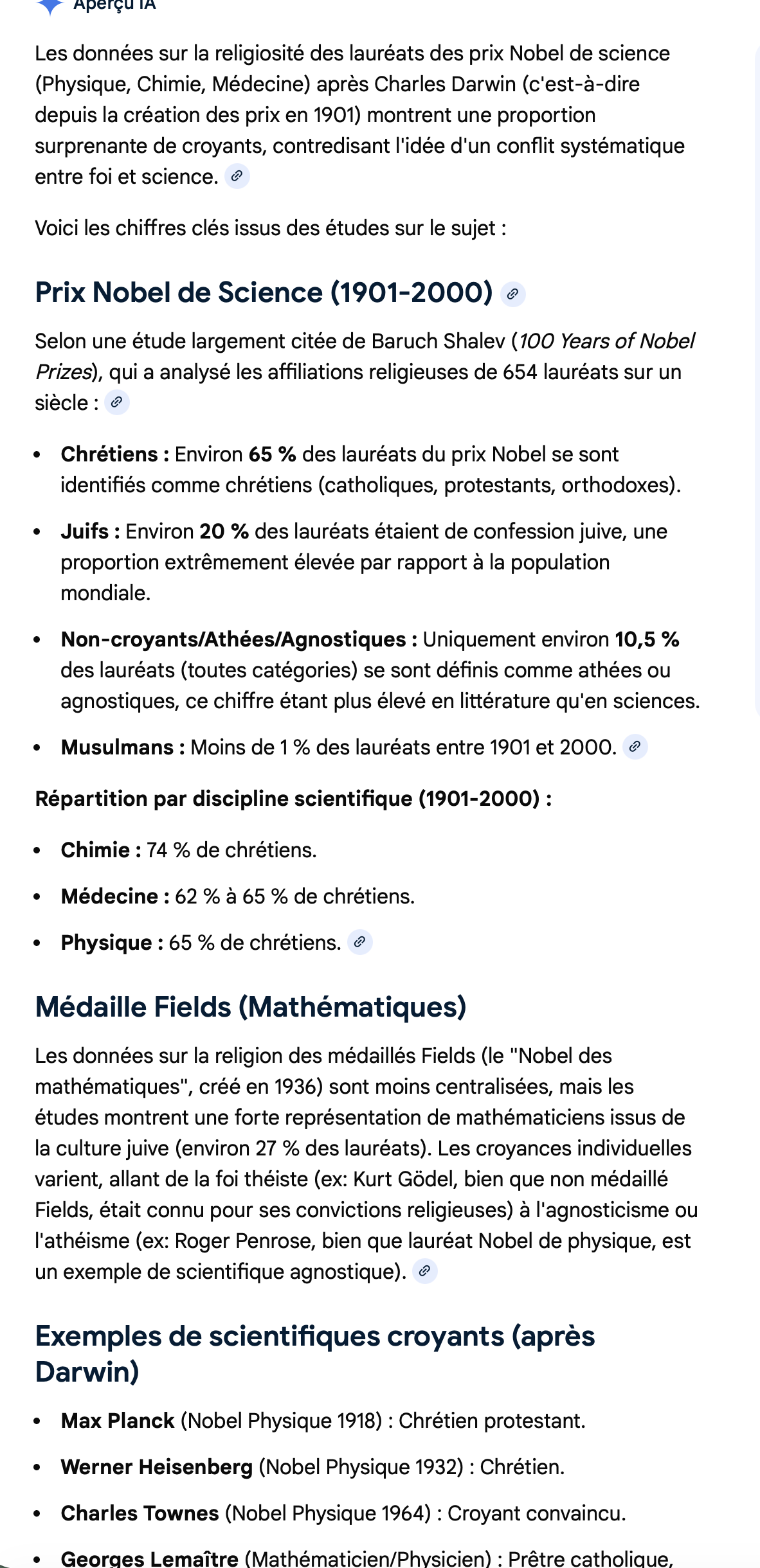
Baruch Shalev, 100 Years of Nobel Prizes (2003) : Analyse statistique des lauréats de 1901 à 2000.
Medium (Universe Magazine) - Religion and Nobel Prizes: What Do the Numbers Say? (2023).
John Lennox - How Many Nobel Prize Winners Believed In God? (2019).
Wikipedia - List of Christian Nobel laureates.